Engineering Architecture
Inside CBS battery engineering.
CBS Flivver assembles lithium-ion packs in Kota from the same cells and BMS boards it supplies. Here is what goes into a pack and how the parts work together.
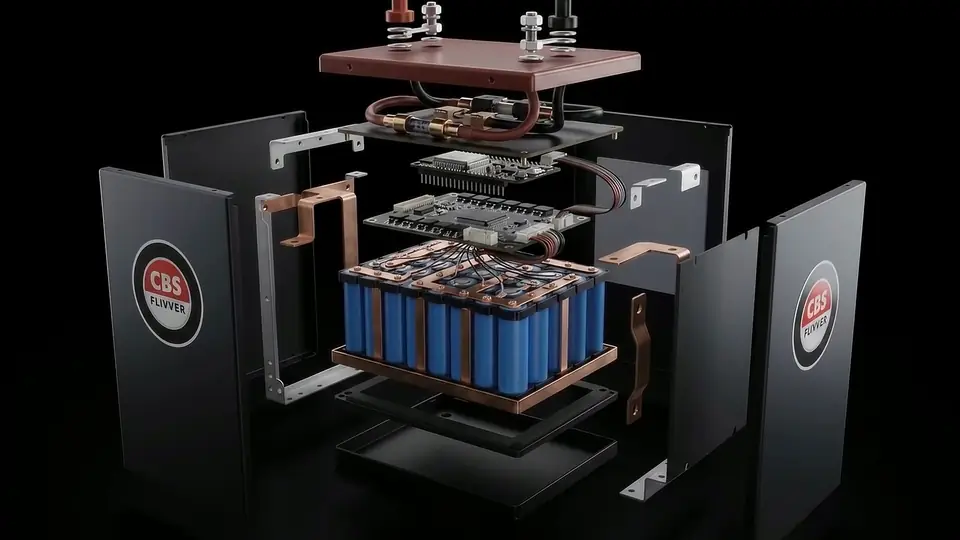
Pack Architecture
Four parts of every pack.
What each part does. Pack-specific data (cell format, cycle life, IP rating, weight) is shared on request once confirmed for your configuration.
Lithium-ion cells
Cells store the energy. They are grouped in series to reach the pack voltage (48 V, 60 V or 72 V) and in parallel to reach its capacity in Ah. CBS supplies 21700 cylindrical cells and 100 Ah prismatic cells; the cell format used in a specific pack is confirmed at quotation.
Battery management system (BMS)
A BMS watches the cell voltages and disconnects the pack when limits are crossed, for example on over-charge or over-discharge. CBS supplies BMS boards such as a 17S board used for 60 V-class packs.
Interconnects
Metal strips and busbars join the cells into series and parallel groups and carry current to the pack terminals. Their layout decides how current is shared across the cells.
Enclosure and terminals
The enclosure holds the cell block and BMS in place and protects them in the vehicle. The terminals connect the pack to the vehicle controller and to its matched CC/CV charger.
Assembled in Kota, Rajasthan.
CBS Flivver Private Limited is a lithium battery manufacturer based in Kota, Rajasthan, India. Battery packs, EV conversion kits and custom vehicles are built in the same Kota workshop.
Enquiries
Discuss custom engineering specifications with our team.
Tell us what you need and we’ll get back to you. Mon–Sat, 8:00 am – 8:00 pm.